
Insights
Notes from the rehearsal room .
What we learn coaching people to speak: the habits that undermine good ideas, the techniques that actually transfer, and the occasional strong opinion about presentations.

'Today I feel fine.' 'Again, but higher.' 'Today I feel fine?' 'Higher still.' 'TODAY I FEEL FINE!' 'Perfect. Now do it again, but somewhere in the middle.' This was roughly ten minutes of a recent coaching session, and I promise it made more sense in the room than it does written down. My client was repeating the same five words over and over, climbing and dropping through his vocal range like he was tuning an instrument. Which, in a way, he was. We talk a lot about content in coaching. What to say, how to structure it, where the pauses go. But this session was almost entirely about tone, and specifically, where in your range you're actually speaking from. The One to Ten Scale I use a simple scale with clients: one to ten, one being flat and monotone, ten being so high it sounds unnatural or forced. Most people who struggle with engagement are living somewhere around a three or a four. Safe. Steady. Also, if we're honest, a bit boring. The sweet spot for effective public speaking sits between four and seven. Not because there's anything magic about those numbers, but because that's the range where you can move. You can drop for weight, rise for energy, and the audience actually notices the shift. If you're stuck at a flat four the whole time, there's nowhere to go, and nothing signals to the listener that anything is changing. We spent a good chunk of the session just humming, moving up and down that scale in small steps, before applying it to actual speech. It sounds like a strange way to spend a coaching session. It is a strange way to spend a coaching session. It also works. Tone Is Not the Same as Emotion Here's something that tends to surprise clients. Tone and emotion often travel together, but they're not actually the same thing. You don't need to genuinely feel excited to sound engaging. You can use tone to simulate that energy for an audience, even when the content itself is dry. This came up because my client admitted that when he's talking about certain work topics, ones he doesn't personally find interesting, his tone flattens without him noticing. Which is completely normal. But it's also, I'd argue, the speaker's job to fix. The audience shouldn't have to share your enthusiasm gap. If the content feels mundane, that's exactly when tone has to do more of the work, not less. Some of the most compelling speakers I've watched are ones who can make genuinely unremarkable material sound gripping, purely through tonal variety and physicality. I've seen someone hold a room for fifteen minutes with nothing more than a story about a cancelled flight. Nothing dramatic happened in that story. It was the telling of it that made it land. Treat It Like a Game. That's really the heart of good storytelling. Treat the delivery like a game you're trying to win, regardless of how interesting the actual subject matter is. Your job isn't to have exciting content, it's to make the content exciting. Those are different skills, and the second one is entirely learnable. What Technology Can't Do My client mentioned he's been trying to self coach between our sessions, filming himself on a tripod and running the footage through various tools to check his content. Sensible enough. But I keep coming back to the same point with clients who ask about this. Technology can help with structure, wording, even pacing to some extent. What it genuinely cannot do is tell you how a tonal shift actually lands on a listener, or catch the moment your voice has flattened without you realising. That still needs a human ear. A Word on Confidence and Culture One thing that came up almost as an aside, but which I think about a lot, is how much culture shapes confidence. I've noticed that in more socially open environments, where strangers chat more freely and interactions carry less formality, people generally seem to find public speaking a little less daunting than in more reserved cities. It's not the whole picture by any means, but it's a reminder that confidence isn't purely an individual trait. Environment plays its part too. So if you're working on your own delivery, try the daft exercise. Pick a boring sentence, any sentence, and say it five times at five different pitches. You'll feel ridiculous. You'll also start to hear, properly hear, just how much range you've been sitting on without using it. Right, I'm off to hum in a stairwell somewhere. As you do.

Why Your Face Is Talking Even When You're Not 'Soft face.' 'What on earth is a soft face?' 'It's not a resting face, it's not a smiling face, it's a soft face.' This was a conversation I had recently with a client during one of our coaching sessions. She looked at me like I'd made the term up on the spot. I hadn't, I promise; it's a real thing, and it might be one of the most useful things you can learn if you want to come across as composed in high-stakes situations. This client works in a field where she's regularly in the room with people who are, by her own description, difficult. One colleague in particular is apparently a nightmare to deal with. But here's the thing. That colleague is also, by my client's own admission, an exceptional public speaker. She commands a room. Why? Because she lets her points land. She doesn't rush to fill silence. She doesn't react to every single thing said to her. She sits in it. That's executive presence in a nutshell. It's not about being the loudest voice or the fastest talker. It's about restraint. We spent a good chunk of our session on this. Like a lot of my clients, she has a habit of reacting quickly, nodding a lot, widening her eyes, doing all the things that signal engagement but can tip over into looking a bit desperate to be liked. So we worked on the soft face. Slight nod. Warm eyes. Nothing frantic. It sounds like a small adjustment, but it changes how a whole room reads you. Hands matter too. Flapping gestures, the kind that spread out wide and fast, tend to read as anxious. Centralised gestures, kept closer to the body, read as controlled. I always tell clients this isn't about suppressing yourself, it's about choosing what you project. There's a difference. The Beer Glass and the Paint Brushes I like to test communication skills with daft exercises, and I make no apology for that. One I did with this client involved me describing a pint glass with a man standing in a bucket inside it. Genuinely, that was the image. The point wasn't the picture, the point was pacing. Could she follow the description without me overwhelming her with detail all at once? Could I break it down into digestible chunks and let her process each part before moving to the next? Then we flipped it. She described ten paint brushes of varying sizes against a specific background, and I had to draw what she told me. This one went well. She compartmentalised the information brilliantly, working through it piece by piece rather than dumping the whole picture on me in one breath. It's a small exercise, but it exposes a big truth about communication. Most of us try to say too much too quickly, and we lose people in the process. On AI, and What It Can't Replace This client raised something in our session that I hear more and more from clients: worry about what AI means for her industry. It's a fair concern, and I'm not going to pretend it isn't real. But here's what I said to her. Communication is one of the few things that genuinely can't be automated in the way people fear. You can generate a script, you can generate a summary, you can generate a perfectly worded email. What you can't generate is presence. You can't generate the ability to read a room or hold a pause the way that difficult but brilliant colleague of hers does. That's a human skill, built through practice and, frankly, through being a bit uncomfortable while you learn it. Mastering communication isn't a nice to have anymore. It's a genuine differentiator. Progress Is Slower Than It Feels This client and I have been working together for eight to ten weeks now, and she said something I hear a lot: that progress feels slow. I always push back on that. When you're in it, week to week, of course it feels slow. You're comparing yourself to yesterday, not to where you started. But when I go back and watch her early recordings against where she is now, the difference is obvious. It's a steady incline, not a straight line, and that's exactly how skill development works. I had a similar realisation with a twelve year old client of mine recently, who has ADHD. He looked bored throughout our whole session. Genuinely, I thought I'd lost him. Turns out he was absorbing every word. It reminded me that engagement doesn't always look like engagement. Progress doesn't always look like progress either. Sometimes you just have to trust the process and keep showing up. So if you're working on this stuff yourself, whether it's your face, your hands, your pacing, or just your general presence in a room, be patient with yourself. Record your sessions if you can. Watch them back with some distance. You'll be more objective about your own growth than you think, and you'll probably surprise yourself. Now, if you'll excuse me, I have a pint glass with a man in a bucket to go and draw.
You’re good at your job. Like, properly good. You know your stuff, you fix problems, and if there were a points system for being competent, you’d be smashing the leaderboard. So why - WHY - does it feel like you’re not being taken seriously? You explain things clearly. You don’t waffle. You’re not a show-off. You get results. And yet… Someone louder - and let’s be honest, not necessarily smarter - ends up getting the credit, the confidence vote, or the promotion. Been there? Here’s the kicker: Your work isn’t meant to speak for itself. That’s your job. And it’s not about turning into a LinkedIn influencer or speaking in TED Talk soundbites. It’s about understanding that in your world - the grown-up, high-stakes, technical one - being brilliant isn’t enough if no one realises it. What people hear vs. what you say. Here’s the plot twist no one warns you about: If you hedge every answer with “I might be wrong, but…” If your voice goes up at the end like you’re asking permission to exist If your body says “please don’t look at me” while your brain’s solving the problem… Then people stop hearing your expertise. They hear uncertainty. Even if you’re right. Especially if you’re right. Okay, so what now? No, you don’t need to “fake confidence.” You don’t need to pretend you’re something you’re not. But you do need to give your brilliant brain the packaging it deserves. That means learning how to say what you know in a way that lands. Because people don’t just listen to facts. They respond to delivery. To tone. To conviction. To the subtle signals that say: “I know what I’m talking about, and you can trust me.” The good news? This isn’t a personality makeover. It’s a skillset. And we can build it. If this sounds like something you’ve felt (or shouted about on the way home from work), you’re not alone - and you’re not broken. You're just under-heard. Let’s fix that!

How Learning a Language Has Helped My Communication and Coaching Skills ‘Grathias.’ ‘Tom, why are you adding a lisp to your words?’ ‘Isn’t that how you’re supposed to do it?’ ‘No!’ This was the moment I realised I wanted - or even needed - to learn a language. I’ve always dreamt of moving abroad, and more recently, that dream has developed into moving to Spain. Both of my older cousins live there, and when I was visiting in 2022 for New Year’s Eve, I felt ashamed of my lack of language skills - and inspired by theirs! Okay, it wasn’t just the shame of adding a lisp to cerveza, or sin, or queso - I also wanted to be able to explain my dietary requirements to the waiter. Sin carne, sin queso, sin pescado, sin divertido. That’s because I’m a vegan! It’s quite stressful explaining this in a country where they consume a lot of fish. Once, I asked for the salad without chicken, and they brought it out with tuna on it. ‘I said without meat,’ I said pleadingly. ‘Yes, sir, but this is tuna.’ Fair point, I suppose – but it was time to rectify this issue! As a coach myself, I never really vibed with the idea of being coached. I liked being the teacher, I liked being the ‘expert’ in the subject – and I loved helping people. I logged onto Preply, which is a coaching site for people like me who want to learn. I was keen! I found Ana - a wonderful lady from Colombia who now lives in Norway with her husband and their beautiful baby. I’m not sure she knew what she was getting herself into, to be honest - I’ll chew your ear off in English, but in Spanish? Eeesh. Lesson 1: Oh sh*t - I really don’t know anything. Lesson 2: I still know nothing. Lesson 3: How do you say hello again? Skip ahead, skip ahead - needless to say, I found every lesson incredibly difficult, and I found it embarrassing. Why on earth would I be embarrassed when I’m the pupil? I’m so used to being the coach, to having the answers. I almost wanted to say sorry after every mistake I made. Then the penny dropped… this is how my students feel. I spent a lot of my time saying, ‘Please don’t apologise, it’s fine!’ or ‘This is a new skill - of course it’ll take some time.’ So why couldn’t I practise what I preach? Because no one likes being bad at something, right? Lesson 20: Oh - did we just have a very basic conversation in Spanish?! This changed my perception of learning. I think it’s because I never liked learning. I love teaching, but I never really took to learning. This was the first skill I’d learned outside of an educational institution - and I was loving it. It also changed my perception of coaching. Ana has a style - especially with newbies (like me): patient, smiley, friendly - the list could go on. But it’s that last one for me. She wasn’t really my coach; she was my friend who frequently corrected my Spanish. We’re always more comfortable making mistakes around our friends than we are with strangers - because friends understand, or at least we think they do. I don’t know if this was conscious, Ana - but thank you. So! This is great. I know a bit of Spanish, and I’m a better coach for my clients due to the shift in my perspective on learning. What next? Ana is retiring to become a breathwork coach. Selfish! AND I need to go to Spain in June for my cousin’s 30th birthday. This means I have to speak Spanish… in Spain? Oh dear, dear me. Learning the language and having the confidence to speak it with a coach is one thing - being stubborn enough to speak it in the actual country is another. Anyway, the less said about that, the better. I was sh*t scared and hated every interaction I had. ‘¿Tienes mayonesa vegana?’ ‘Yeah, we do’ - they would always reply in English! ‘Thanks.’ Not even a gracias from me - or a grathiathhhhhhh. I spent a lot of time telling my clients to use the tools I’d taught them. They needed to put them into practice. But that’s much easier said than done - as I’d recently discovered. I needed to step this up a notch. I had to find a way to take what I’d learned and actually use it. Enter Nora. Nora is my current Spanish teacher - and a very good friend. She’s taught me that aligning passions with learning is the way forward. Why not learn all about The Lord of the Rings in Spanish? Why not discuss anime, movies, vegan food - all the things I love - in Spanish? Nora is from Venezuela and lives in Argentina. Her English is immaculate, and her fascination with my pronunciation of the word ball will always make me laugh. She sets goals for me: The next time you go to Spain, try to tick off these three things. The time after that - go a little further. You are to only speak Spanish - even if it’s rubbish. And now I do! Now, we only speak in Spanish in our lessons. Skip forward three years, and I can sort of speak Spanish - I can sort of hold a conversation. This is all down to the coaching style I’ve received. It’s taught me that learning as an adult is hard. It’s taught me that putting new skills into action is scary. It’s taught me that a good teacher is like gold dust – and luckily, I’ve had two. It’s reminded me that communicating with new people is unfamiliar - and can be frightening. I find it easy in English, but Spanish has reminded me to empathise with my clients. Don’t give up - the first few months are horrid, embarrassing, slow, and feel pointless. Push on!
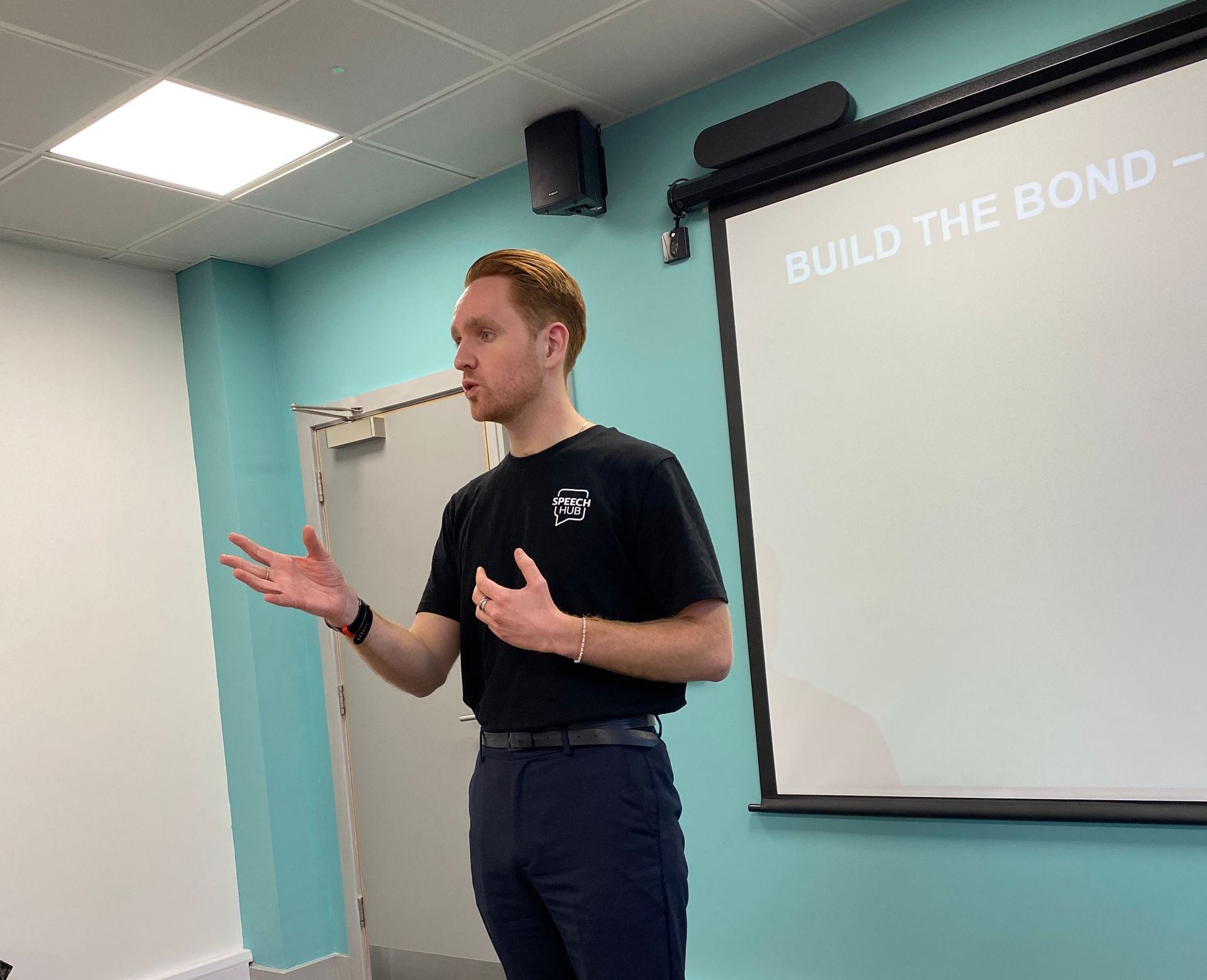
This post guides readers through basic vocal warm ups for public speaking